
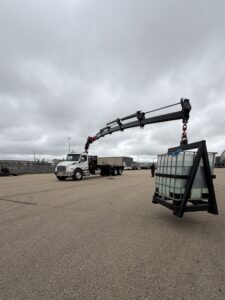
So you have just mounted a new crane to your truck chassis. Perhaps it’s an Articulating Crane such as an Hiab or Palfinger. It could also be a boom truck such as a Manitex or Weldco Beales. Are you required to have a stability test performed on the new configuration in Alberta? This is a common question we get asked, and it seems like there is different answers swirling around in the industry. I am hoping this article can help clear up any confusion, and get you on the right track.
Lets clear up one thing, it doesn’t matter if you are mounting a used crane or a new crane to a truck, they are both considered new configurations for the purpose of this article.
First, we need to look at the Alberta OHS legislation as that is what governs the industry here. There is no exact wording in the OHS code that says you must stability test your crane. However, there are some other words in the code that we need to look at. The first one to look at is that Alberta OHS says cranes need to follow CSA Z150. We will dive into Z150 in the next paragraph, but first I want to bring up some other things that OHS can use. They have this generic wording that OHS officers like to use to enforce rules. The one I am thinking about in particular is the employer must ensure, “as far as it is reasonably practicable,” the health, safety and welfare of its workers. That is broad enough that an OHS officer could potentially say something like: even if there is no clause that literally says “a stability test must be performed,” the employer knew or reasonably should have known that crane instability was a potential hazard and failed to take a reasonable measures to confirm that the crane remained safe. To me this is the most important reason why you should have a stability test done for your crane in Alberta. It may seem inconclusive using generic wording like this, but there is a reason why OHS has that wording in their. And they have used it in the past to get convictions for something that didn’t explicity say you needed to do.
So lets get into CSA Z150 now. Unfortunately, it doesn’t give exact wording either. There is nowhere in Z150-98 that says you must stability test your crane. However, it does say that where load ratings are governed by stability, they are to be established as percentages of the crane’s tipping load. How are you supposed to know the crane’s tipping load without testing it in real life.
The last option we will look at is the OEM installation manual for the crane. Now unfortunately I don’t have access to every manufacturer’s manuals, but from the research I have done most OEMs require stability testing to be done after the crane has been mounted to a truck. Which in the end it would make sense for the OEM to require something like that from a liability standpoint. Since the OEM requires stability testing, that now brings us full circle on this whole topic. Since Alberta OHS says you must follow the Manufacturer’s requirements, that means you must perform a stability test on a new configuration.
So, is a stability test required after mounting a crane onto a truck chassis in Alberta? While the legislation may not explicitly say so, there are several requirements that point toward the importance of verifying the stability of the completed installation. Between Alberta OHS’s general duty to protect workers, CSA Z150’s stability requirements, and the installation instructions of manufacturers that specifically require stability testing, there is a strong case for having it done. At the end of the day, every new crane and chassis combination is different, and just because a crane was stable on one truck doesn’t mean it will be stable on another. My recommendation is simple: have the completed installation stability tested and documented before putting the crane into service. It’s a relatively small investment that helps protect your workers, your equipment and your business.
Ultimately, if an incident ever occurs, you don’t want to be trying to explain why you assumed the crane was stable.
You want documentation showing that you took reasonable steps to verify it.